At Chinook Propulsion Technologies, we're advancing the future of high-speed mobility by unlocking the full potential of air-cushion and advanced propulsion technology. The concepts at the heart of our work aren't new. They were sketched, tested, and ridden by passengers more than half a century ago. What's new is everything around them.
A Province Built on the Pursuit of Speed
Alberta has always been impatient with distance. The journey between Fort Edmonton and Fort Calgary took five days by stagecoach in the 1850s; passenger rail in 1883 cut that to twelve hours, and by 1930 it was under seven. In 1936, The Chinook — the train that gave our company its name — pushed travel along the corridor down to five hours at speeds approaching 120 km/h, a benchmark that held for nearly fifty years.
That history matters, but it's only the prologue. The more interesting story was unfolding an ocean away.
A Parallel Revolution in Britain and France
While Alberta was settling into the rhythm of conventional rail, engineers in Britain and France were tearing up the rulebook entirely.
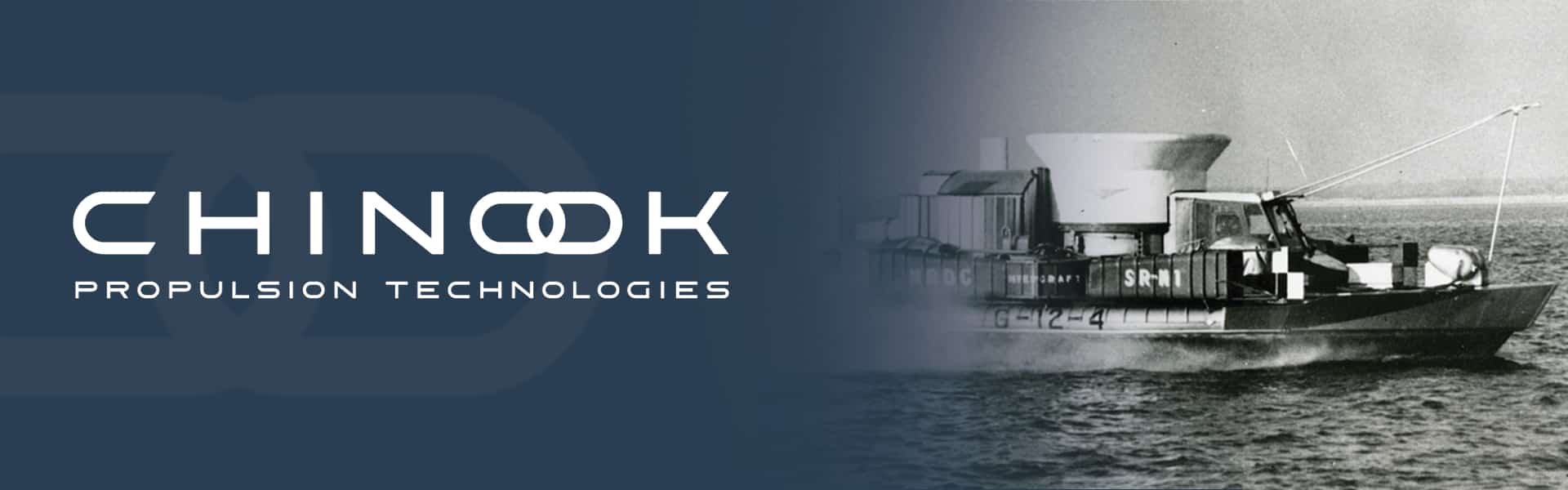
In the United Kingdom, Christopher Cockerell — a radio engineer turned inventor — patented the hovercraft principle in 1955. By 1959, his SR.N1 prototype was crossing the English Channel on a cushion of air. Cockerell's insight was deceptively simple: if you could lift a vehicle just slightly off its surface, you could eliminate the friction that had defined ground transport since the wheel. British engineers extended the principle from water to land with the Tracked Hovercraft programme, building a guideway-riding prototype that hit 167 km/h on a test track in Cambridgeshire before government funding was withdrawn in 1973.
Across the Channel, Jean Bertin was running parallel — and arguably more ambitious — experiments. His Aérotrain, developed in France through the 1960s and early 1970s, was a sleek vehicle that floated above a concrete guideway on cushions of air, propelled first by ducted propellers, then turbojets, and finally linear induction motors. In 1974, the Aérotrain I80 reached 430 km/h on a test line north of Orléans — a speed that wouldn't be matched by conventional rail in France for years afterward. Bertin's company also developed the Naviplane hovercraft and licensed air-cushion designs around the world.
These weren't drawings on a napkin. They were full-scale, passenger-rated vehicles, hitting speeds that today's fastest commuter trains still can't match. Britain and France had built the future. They just couldn't quite afford to keep it.
The Right Idea, the Wrong Decade
By the late 1970s, air-cushion ground transport was in trouble — not because it didn't work, but because the supporting world hadn't caught up. France cancelled the Aérotrain in 1977 in favour of the TGV, which used proven steel-on-steel technology and could share the existing rail network. The Tracked Hovercraft had been scrapped years earlier on similar grounds. Diesel-electric locomotives were cheaper to deploy in the near term, and there was no political appetite for building a parallel infrastructure of dedicated guideways.
The technology hadn't lost its merits; it had been lost due to the lack of an appropriate technological ecosystem around it. Composite materials weren't yet light or strong enough at scale. Power electronics for high-efficiency electric propulsion were a generation away. The digital control systems needed to keep a near-frictionless vehicle stable at 400 km/h existed only in research labs. Manufacturing capable of producing precision components at transit volumes was decades out. Cockerell, Bertin, and their teams had reached for something the surrounding industry simply couldn't yet deliver.
Why the Conditions Are Finally Right
In the last fifty years underlying physics that made tracked Air-cushion vehicles attractive have not changed; air still lifts, friction still holds you back. What has changed is everything else. Advanced composites and aluminium-lithium alloys make the structures Bertin would have killed for. Permanent-magnet motors and silicon-carbide power electronics deliver propulsion efficiencies that would have seemed fantastical in 1974. Real-time digital control, modern simulation, and additive manufacturing collapse what used to be decade-long development cycles into a few years. The supporting industries — battery, sensor, software, materials — are no longer adequate but world-leading.
For the first time, the engineering envelope around air-cushion transport is finally wide enough to contain it.
The Infrastructure Advantage
Conventional high-speed rail is expensive less because of the trains than because of the track beneath them. Steel-on-steel systems running at 300+ km/h demand alignment tolerances measured in millimetres — every metre of guideway has to be ground-prepared, surveyed, laid, and maintained to a precision that drives costs into the tens of millions per kilometre and timelines into decades. It's why most high-speed rail proposals in North America die in the budgeting phase.
Air-cushion vehicles don't carry that burden. The cushion itself is a compliant interface: the vehicle rides on a layer of pressurized air that absorbs minor variations in the guideway surface rather than transmitting them as force into the structure. Tolerances loosen by an order of magnitude, and the engineering economics shift with them.
That tolerance margin is what makes modular, precast guideways viable. Segments can be cast in a controlled factory environment, trucked to site, and lowered into place by crane — closer to bridge construction than traditional railway laying. Precision is built in at the plant, not extracted in the field by specialist crews working remote stretches of corridor. The result collapses both the cost and the timeline of getting high-speed transport into service: less surveying, less ground preparation, less labour bottlenecking, and dramatically more parallel construction across the corridor at once.
Taken together, this is a deployment path no previous generation of high-speed rail has had access to — faster to build, lower in cost per kilometre, and amenable to phased rollout across long corridors rather than the all-or-nothing megaprojects that have stalled the technology in nearly every market that's tried it.
Why Alberta
Alberta was named in 1882 for Princess Louise Caroline Alberta, a daughter of Queen Victoria — a direct thread back to the same Britain that gave the world Cockerell and the SR.N1. The province's other founding culture is French: from the voyageurs and Métis of the fur trade era through to the francophone communities of St. Albert, Legal, Bonnyville, and Beaumont — the same heritage that produced Bertin and the Aérotrain.
The two nations that pioneered air-cushion propulsion are two of the founding cultures woven into this province's foundations. Their engineering traditions have descendants here — in our universities, our energy industry, our manufacturing base — and those descendants are now equipped with tools the original developers could only dream of.
Pair that heritage with Alberta's modern advantages — long, straight corridors between major economic centres, a sophisticated engineering workforce, geography that rewards anyone who can move further and faster — and the case for building this here writes itself.
Introducing FlightTrain
Nearly ninety years after The Chinook set the standard for speed in Western Canada, we're building the next chapter: FlightTrain.
FlightTrain is the inheritor of the work Cockerell and Bertin began — adapted, modernized, and engineered for the corridors that matter to Albertans. It is designed to achieve ultra-high speeds with dramatically reduced friction, to operate efficiently across key regional corridors, to simplify infrastructure relative to traditional rail, and to reconnect the province at a pace closer to flight than to driving.
For the first time in Alberta's history, frictionless high-speed travel is no longer a thought experiment. The technology exists. The supporting industries exist. The geography is ideal. And the heritage running through this province is, quite literally, the heritage of the people who imagined this in the first place.
Building What Was Always Possible
We're picking up a thread that two great engineering traditions laid down decades ago and weaving it into something the world is finally ready for.
Sometimes the most transformative innovation isn't new. It's simply ready – and finally, so are we.