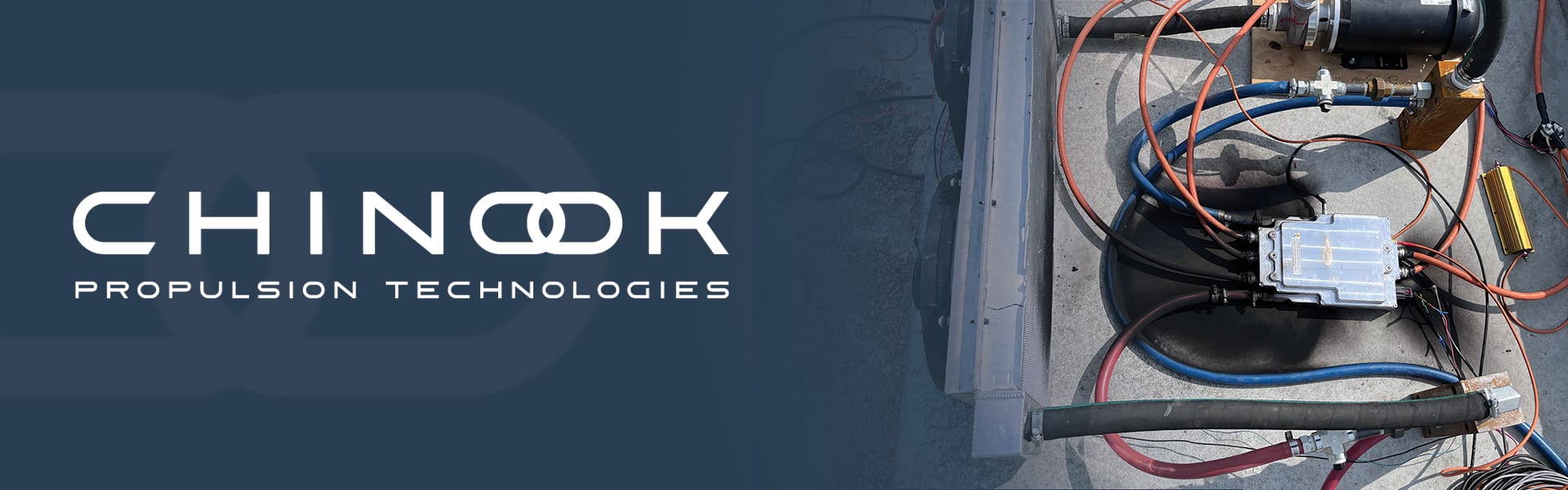
Developing a new approach to high-speed rail means testing more than just how a vehicle moves. At Chinook, our air cushion train relies on hovercell technology to lift the vehicle above the guideway, creating the foundation for a different way to move at high speeds.
As with any new system, progress comes through testing, learning, and refining. During recent single-hovercell testing, our team encountered an electrical system issue that resulted in a major component failure. It was a setback, but it also gave our engineers valuable insights into how they could improve the hovercell system.
Pushing the Systems to Their Limits
By the time the incident occurred, the team had successfully tuned the motor and its controller and completed a number of repeatable hover tests.
With confidence in the system growing, we began increasing motor speed to explore its operating limits. But as we pushed toward higher RPM, we repeatedly encountered an overvoltage fault before reaching our target speed — and below what we believed the system should be capable of handling.
The team shifted into diagnostic mode.
We made adjustments, reviewed the data, and repeated the hover test after each change. Despite those efforts, we continued to encounter the same RPM limit, with the system shutting itself down because of excessive voltage.
Eventually, those repeated overvoltage events took their toll on the inverter — the electronic device responsible for controlling the motor. The inverter released what engineers affectionately call the "magic smoke" that electronics need to keep working.
In this case, there was also a small fire inside the inverter. Fortunately, our safety protocols worked exactly as intended. No one was near the equipment while the system was operating under load, so there were no injuries or near misses. The result was a damaged inverter and perhaps a few bruised egos, but nothing more serious.
Testing Reveals What Design Alone Cannot
Following the failure, we brought the system back to the shop, disassembled it, and began a much deeper investigation into what was happening electrically.
Engineering models, simulations, and design reviews are essential to developing new technology. But there is only so much that can be learned before a system is put through real-world conditions.
Our investigation determined that as the motor reached higher speeds, it was generating electricity and feeding that energy back into the electrical system. This is a normal characteristic of electric motors under certain operating conditions. However, in our particular setup, the amount and frequency of that returned energy were greater than what the inverter could repeatedly withstand.
The result was a failure that we could not have fully understood by looking at individual components in isolation. System testing allows engineers to see how those components behave together. When something doesn't perform as expected, the goal isn't simply to identify what failed, it's to understand why it failed and what that teaches us about the system as a whole.
Turning a Setback into a Solution
The failure ultimately gave us a much better understanding of how the complete electrical system behaves under real operating conditions.
With that information, our team modified the electrical system to safely manage the energy being returned by the motor. We are now testing those changes before returning to full-power hover testing.
This is an important part of research and development. A successful test can confirm that a system is performing as intended, while an unsuccessful test can reveal a limitation, expose an assumption, or point engineers toward a better solution. Both outcomes move the project forward.
Building, Testing, Learning, Improving
Developing new transportation technology requires a willingness to work through uncertainty. There will be components that need to be redesigned, systems that need to be adjusted, and tests that don't produce the expected results.
At Chinook Propulsion Technologies, we're continuing to build on what we've learned as development progresses. This latest test revealed an electrical limitation, but it also gave our team a clearer understanding of the vehicle and the changes needed to improve its performance and reliability.
Every test brings us one step closer to a transportation system that can perform in the real world.